13th International Summer School on Digital Government - OpenGov2026


The 13th International Summer School on Digital Government takes place on the beautiful island of Samos and focuses on Technologies and Applications for Government 3.0, a really growing, diverse and challenging domain.
The Summer School on Government 3.0 is organized by the Department of Information and Communication Systems Engineering, University of the Aegean and provides a unique opportunity for participants to interact with internationally acclaimed scientists and researchers in the domain of ICT-enabled Governance, to develop their skills in the areas of policy modelling, information management, disruptive technologies in governance, and more.
OpenGov2026 may be of interest to the following:
- PhD Students interested in open government, data-driven governance, and data-driven research;
- Professionals and researchers working on open government and advanced democracy research and interested in new disruptive ICTs in e-government; open data research or open data initiatives; topics related to public values, including transparency and privacy in a governmental context; policy modeling, and data-intensive decision making.
- Senior administrators, policy advisors, government officials or agency members, who are interested in how ICTs change governments and how ICTs can be utilised for public administration
Scope
The aim of OpenGov2026 is to enable participants' involvement in Open and Collaborative Governance issues and their accompanied technologies with hands-on Workshops, interactive sessions and discussions around the most prominent technologies of the domain (e.g., big and open linked data, blockchain, artificial intelligence and machine learning, large language models, crowdsourcing mechanisms, policy modelling and simulation, opinion mining and sentiment extraction, and more), and offer appropriate additional skills towards shaping a successful researcher, a competitive employee and a well-informed public servant.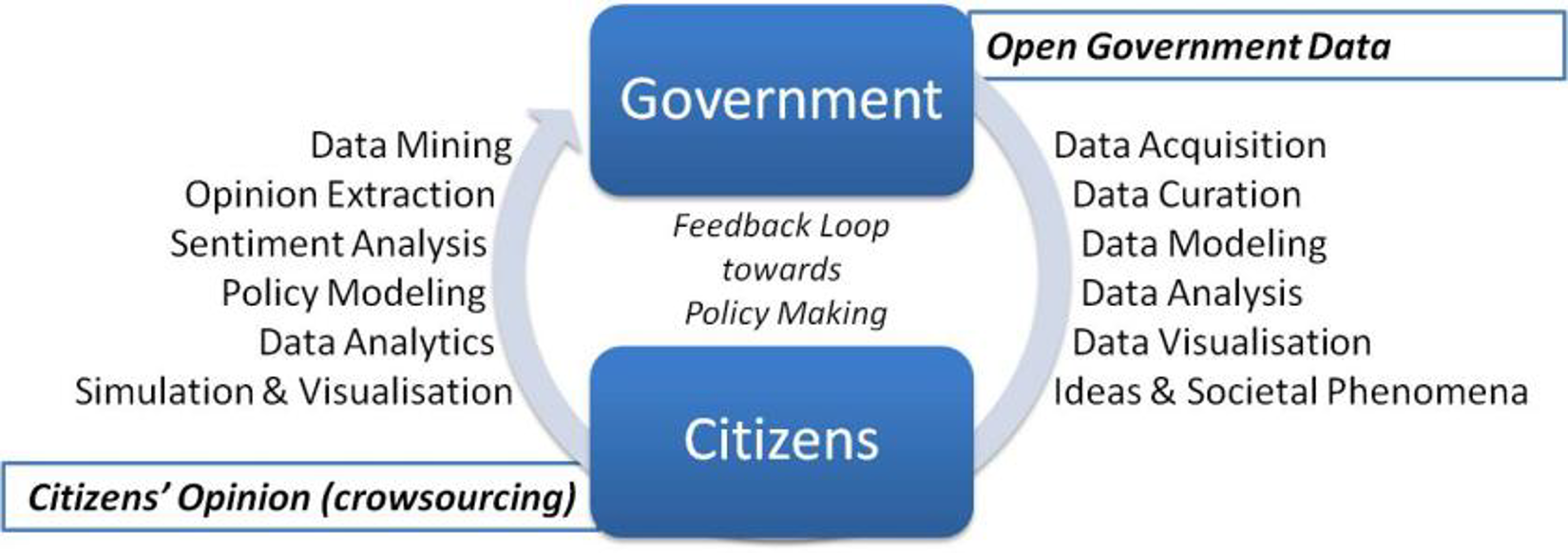 The current state of the art and practice in the area of Electronic Governance has up to now been tackling important problems for administrations and societies such as service provision, automation in the public sector, interoperability and common standards, information systems, security and authentication, and issues of legal nature. At the same time new, highly disruptive ICTs are emerging, maturing and increasingly utilized in the private sector, leading to major transformations, such as big data acquisition and analytics, Internet of Things (IoT), artificial intelligence, bots and agents, data mining, distributed ledger technologies and block-chain, virtual spaces, etc. These ICTs will bring in new opportunities for the public sector and societies, aiming to address severe, social challenges and problems. It is important that these issues are also viewed through the lens of e-democracy. E-Democracy by definition combines technology and democracy and, ideally, is a multifaceted and interdisciplinary research seeking to enhance public rule, citizen engagement, and direct unobstructed accountability, improving the situation for various challenges in society.
 -
Government 3.0 refers to the use of disruptive ICTs (big data and artificial intelligence technologies) in combination with established ICTs (distributed technologies for data storage and service delivery) and the wisdom of crowd (crowd-sourcing and co-creation) towards data-driven and evidence-based decision and policy making.
Topics
The topics addressed by the OpenGov2026 Summer School include a wide range of information and communication technologies and social science issues, covering the whole domain of Digital Government under the following thematic areas:
- AI for Digital Governance (main thematic)
- Big Open and Linked Data services and infrastructures
- Data-driven decision making
- Open Government & E-Democracy
- Policy modelling and electronic policy deliberation (e-participation)
- Large Language Models (LLMs) for digital government
- Interoperable infrastructures: Technical, semantic and organisational interoperability
- Deliberative Democracy. Tools available. Tools to be developed
** Important Information for Participants Applying for Financial Support **
The University of the Aegean, as a partner of the European project AI4Gov-X, offers eligible participants of the OpenGov2026 Summer School the opportunity to apply for financial support through the AI4Gov-X Cascade Funding Scheme under Objective 1.The funding scheme aims to reduce financial barriers to participation in approved AI4Gov-X extracurricular activities by reimbursing part of the eligible participation costs, including registration fees, travel, and accommodation expenses, in accordance with the terms and conditions of the official Call.
Participants interested in applying to the AI4Gov-X Cascade Funding Scheme under Objective 1 are kindly requested to contact Dr Zoi Lachana at zlachana@aegean.gr.
Applicants are kindly requested to carefully follow the application process and timing requirements described below.
Step 1 - Apply to the Summer School: Participants must first complete the registration/application process for the Summer School using the form: https://summer-schools.aegean.gr/en/opengov2026/Application-Form
Step 2 - Receive Acceptance Confirmation: After review of the application, accepted participants will receive an official confirmation/acceptance email. This confirmation is required for the Cascade Call application.
Step 3 - Submit the Cascade Call Application (Objective 1): Before making any eligible payments, participants must submit their application to the AI4Gov-X Cascade Call through the GoodGrants platform.
Important: According to the Call rules, eligible expenses are only those realised after the date of submission of the Cascade Call application.
For this reason, participants must submit their Cascade Call application before paying registration fees, travel costs, accommodation costs, or other related expenses.
Step 4 - Proceed with Payments: After submitting the Cascade Call application, participants may proceed with: - Registration fee payment
- Travel bookings
- Accommodation bookings
- Other eligible expenses
Participants should keep all invoices, receipts, and proofs of payment.
Step 5 - Attend the Summer School: Participants must successfully attend and complete the Summer School activity.
Step 6 - Submit Supporting Documents for Reimbursement: After completion of the Summer School, selected beneficiaries may be requested to submit:
- Proof of participation/completion
- Invoices and receipts
- Proofs of payment
- Any additional reporting documents requested by POLI.design
Step 7 - Reimbursement: Payments are normally processed by POLI.design after successful participation in the activity, approval of the beneficiary report, and approval of the cost statement along with the supporting documents.
Important Reminder
Submitting an application to the Cascade Call does not automatically guarantee funding. Applications are evaluated jointly after each cut-off date according to the official evaluation criteria of the Call, and participants are encouraged to apply as early as possible before the relevant cut-off date.
The reimbursement scheme for Objective 1 covers up to 50% of eligible costs, within the limits established by the Call.
Useful Links - Call Page
- AI4Gov-X Call Description & Q&A
- GoodGrantsTM submission platform
- OpenGov2026 Official Website
Venue
The OpenGov2026 Summer School will be held at Provatari building.